Going Mobile: How to Optimize your Apps for Facebook Mobile


When Facebook announced in October that it would extend its platform to mobile social apps, social marketers everywhere were fired up. After all, Facebook is increasingly becoming a mobile magnate: currently, more than 350 million active users log in to Facebook on their mobile devices -- that’s nearly 40%of Facebook’s membership!


So how can brand managers take advantage of these new capabilities? Wildfire’s Page Manager offers brands the ability to create a seamless end-to-end Facebook experience, regardless of whether users view Facebook content on their desktops or their mobile devices.


Facebook’s Mobile Platform
Prior to the December 2011 release, the only way to deliver app content to mobile users was to host it on a mobile website outside the Facebook ecosystem. By using this approach, a brand could link to an app from its fan page, and a mobile user who clicked the link was redirected to a website in his mobile browser, outside Facebook. This was less than ideal for a few reasons. First, numerous studies have shown that Facebook users are inherently distrustful of processes that route them outside of Facebook (doing so can result in high bounce rates, among other things). Second, removing users from the Facebook ecosystem prevents the app from tapping into the viral nature of Facebook’s platform, such as the ability to share app content with friends.


The mobile app platform that Facebook created solves these problems by driving mobile users to canvas pages, where they can directly view and engage with app content after clicking links that appear in their newsfeeds.

Wildfire’s Mobile Solution
To provide an optimal user experience for Facebook mobile apps, marketers must deliver content to mobile users in a way that allows users to view and interact with it in the native Facebook app. Let’s walk you through an example using Wildfire’s mobile page management.

Our fictional company, Big Grin Greeting Cards, wants to spark conversation with its community of fans. To achieve this, Big Grin launches a Wildfire “Storyteller” application, which it uses to ask fans compelling questions within the application (and also allows users to easily post the conversations to their news feeds, spreading earned media about Big Grin!). By leveraging Page Manager’s mobile app capabilities, Big Grin can extend a branded experience to Facebook users on their mobile devices. The screenshots below depict the user workflow:


1) Within Page Manager, Big Grin publishes a new question to its Storyteller application. The page administrator then posts a status update on the company’s Facebook fan page that includes the question (prompting users to submit their thoughts), and a mobile-friendly link to the Storyteller application. Desktop users click through the link and land on the application page as usual. Mobile Facebook users see the update in their news feeds, and click through for a mobile-optimized Facebook app experience.


2) After Big Grin’s fans submit their responses to the community question, the Storyteller app posts users’ responses to their news feeds and Timelines (the functionality works for mobile and desktop users alike). These posts display branded content and link back to the application on Big Grin’s fan page. This generates earned media for Big Grin.


Now that Facebook has developed the technology necessary to publish apps to mobile, Wildfire provides a marketing solution that gives Facebook users a seamless viewing experience, regardless of whether they consume branded content on a mobile device or desktop. As speculation increases that Facebook will soon support ads on its mobile site and push Sponsored Stories to users’ news feeds, having the ability to launch mobile friendly Facebook apps like the Storyteller app is a great way to begin monetizing your mobile efforts!

Have questions about mobile functionality for Facebook apps? Drop us a line in the comments, we’ll do our best to help you!

read more...

Measuring the Business Impact of Social Media [INFOGRAPHIC]

Social media is no longer a stop-and-go investment, but rather a long term strategic channel that, when integrated with other marketing efforts, allows brands to connect with users over time. Results of a recent survey we conducted find social media efforts valuable in their ability to grow brand awareness and increase dialogue with customers. In addition to spending more time thinking about how to engage audiences, marketers will soon begin to measure social media's impact on the business through a more traditional ROI definition: attributable sales and costs.
In November 2011, we conducted an ROI survey of over 700 marketers from all around the World. The results were compiled into an easy-to-digest infographic, found below.


What do you think of the results? Where does your brand fall in line with these alignments?

read more...

Social 2.0: Social Media Marketing Outlook for 2012 [WEBINAR]

On January 17th, we broadcast a live webinar for over 1,000 attendees, discussing the findings of our report about changes in best practices for social media marketing in 2012. If you missed the webinar, your chance to watch the recording and get ahold of the slides is here.
read more...

2012 in Social Media: The Next Generation of Social Marketing


Summing up social marketing in 2011 and making predictions for the coming year is a daunting task! 2011 saw more industry growth than any other year; we saw the widespread acceptance of social marketing for B2B companies, and we witnessed moments that are likely to echo beyond 2011: the debut of Google+, the introduction of Facebook Timelines, and an amusing concession to social media silliness by the White House, via the now infamous rickroll.

* This post was originally published in the Huffington Post.

On the local front, we asked our Account Strategists about their observations of trends over the year. Our team of strategists works every day with the biggest brands in the world, hands-on in helping to craft and maintain the strongest social marketing strategies on the web. Our marketing strategists noted a dramatic rise in clients’ needs to set specific marketing objectives for each social campaign. Objectives fell into three key areas:

  1. Growth of the brand presence (fans, likes, follows, and subscriptions)

  2. Engagement of the brand audience (comments, shares, and user generated content)

  3. Monetization of fans (qualified leads, or sales driven from social pages)

Before 2011, social marketing efforts focused almost exclusively on growth – in a recent Wildfire survey, social media marketers noted “growth of fans or followers” as the top measurement of success, and the primary definition of positive ROI. We predict a shift from the emphasis on growth in the coming year as engagement becomes the most buzzed-about measurement of 2012. The generalized category of “social media marketing” will break apart too, with more specific business objective-based goals and models to achieve those goals.

In 2011, we saw little integration between branded social campaigns and the brand’s other marketing activities. You might have seen one editorial campaign on a brand’s website, only to see something different on Facebook, with no mention of either initiative via the brand’s email, television or radio channels. Too often consumers found themselves on a brand’s Facebook page served with a message absent elsewhere. Progressive brands will approach their marketing plans with an integrated social channel— more than just a messaging strategy, or a page content calendar, or a promotions schedule, winning brands will need figure out how all the pieces of the social puzzle fit in with a complete marketing plan.

In 2012, Wildfire predicts that the industry will follow an integrated social campaign approach, following the example of savvy social marketers like So Delicious, who linked their "Change Your Milk, Change Your Life" efforts across TV, outdoor, online and print advertising. The campaign, centered around celebrity spokesperson Jillian Michaels, reflected the brand's message about changing ones life and reached audiences on Facebook, Twitter, MySpace, the company’s website, the company’s blog, Youtube, and in print.

The effort was worth it: the results from just one of the 3-month, Wildfire-powered campaigns, were enviable, as So Delicious grew its fan base from 5,200 to over 59,000 fans - an increase of over 1,000%! The brand received 322,664 total entries, averaging 3,226 entries per day. So Delicious recorded its two highest sales days ever, while unit sales increased by 74%, and category share increased by 60%.

In 2012, integrated marketing efforts will swallow standalone social media plans, and more companies will follow the approach that one major initiative should guide the objectives and editorial plans of each marketing channel.


In 2011, users got a lot more sophisticated in how they use social networks. In fact, we saw that a user’s initial interest in a brand socially was no indication of whether they would stick around for the long haul. Top reasons cited for “unliking” a brand on Facebook included: “they post too much” (44%), “my wall was becoming too crowded with marketing posts and I needed to remove some of them” (43%), and “the content became repetitive or boring over time” (38%).In 2012, brands that want to develop long-term relationships will make sure to deliver consistent value and entertainment to their audiences. “Likes” will be granted more selectively (as users increasingly get how liking a brand reflects their personal taste, for better or worse). We will see more unique, targeted content, and more sophistication in promotions as well, as those ubiquitous iPad giveaways lose their positive brand impact. In fact, our customers’ top 250 campaigns of 2011 prove it — none of the campaigns gave away an iPad. Prize giving was more strategic and audience relevant, and prizes reinforced the brand.

In addition, more descriptive and frictionless sharing of people’s actions beyond the “Like” is already underway with Facebook’s support for social applications. In this way, endorsements made by friends will extend further and further past just the “like,” to include any variety of enticing action words like “played,” “watched,” “shopped,” and “read.”

Finally, in 2011, Facebook and Twitter gave customer service a kick in the rear. Social media is supposed to be a two way street, and consumers are treating branded pages as message boards that go straight to the board room (two such fiascos—both unscripted “celebrity versus airline” disputes involving Kevin Smith and Alec Baldwin — made big waves this year, for example). In fact, 62% of consumers used social media for customer support! While most brands have a long way to go for true interaction (approximately 95% of fan-written wall posts go unanswered), more and more users are demanding (and businesses are responding) that any brand who asks for their affinity, had better be responsive to their requests as well.

While this post doesn’t cover all of 2011’s social media industry trends and predictions (find the complete report here), keep an eye out for more targeted social marketing objectives, integrated campaigns, increased user sophistication and preferences, and the rise of social for customer service in 2012. Download the complete report, including several marketing trends not mentioned in this article, here.

What do you think of the trends and predictions we mentioned? What would you add?

read more...

Facebook to Place Sponsored Stories Ads into Users' Newsfeeds

A big change was announced for Facebook advertisers today: starting in January, Facebook will be featuring “Sponsored Story” ads in users’ news feeds. Until now, all advertising on Facebook was limited to display only within the right panel of the interface. This change will greatly increase the marketing presence of brands advertising Facebook, expanding the exposure of these “organic interactions” ad units (as Facebook refers to Sponsored Stories).


In case you’re not aware, Sponsored Stories are a Facebook advertising format—Facebook defines them as stories that are “eligible to appear in your News Feed.”  Sponsored Stories show up, like traditional ads, on the right column of pages on Facebook. Companies can choose different user actions — such as posts, likes, check-ins or actions within Facebook apps — and feature them in their ad campaign. Facebook says that unlike traditional ads, “Sponsored Stories help to drive authentic and scalable word of mouth,” because the ads stem from real user interactions and are shown to all of that user’s friends. Here are some examples of Sponsored Stories you’ve probably already seen in your Facebook account:


  • “App Share” Stories are created when a user starts using a Facebook app

  • “Page Post Like” Stories are created when a user “Likes” one of the posts made by your page

Sponsored stories in the news feed will be the same size as other items that feature on it and will be displayed with a link that reads "Sponsored" underneath the post. Users who mouse over the link will see the text: "This was already shared with you. A sponsor paid to feature it here."

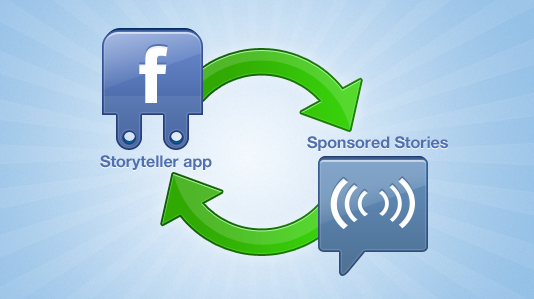
This is great news for marketers, and for Wildfire. Earlier this year, we announced the Wildfire Storyteller application, a utility available to all Wildfire Social Marketing Suite clients which allows page administrators to create a place on the page for branded interactions that easily create and encourage feed stories. Using the Wildfire Storyteller app, you can create a tab in your Facebook Page to ask your users fun and engaging questions about your brand. You can then set up an entire customized Facebook Feed Story that gets published alongside that user’s generated response. This feed story is especially powerful in that you can included a branded video or image with the story and you can also customize the feed story title, URL and description. So, for example, a movie brand could use our Storyteller app to ask fans “What was your favorite scene from the Hangover II movie trailer?” and the ad generated from a user’s response could include the movie trailer, a link to buy tickets for the movie, and a description of the movie. As long as you’ve created a Sponsored Stories ad campaign, all of these newsfeed posts create ads targeted to your users’ friends.


Since 27% of all users’ time on Facebook is spent looking through the newsfeed, Wildfire is excited about this new opportunity for marketers to further leverage the viral power of Sponsored Stories.

What do you think of the news that Sponsored Stories will be displayed in user news feeds? Tell us in the comments, we’re excited to hear your opinions!


read more...

HOW TO: Strengthen Your Twitter Brand Strategy in time for the New Twitter Pages


On December 8th, Twitter announced a new version of the network that was designed to make it easier for users to “discover what’s happening now”. You’ve probably already read about the introduction of special pages for brands. The new features are exciting, and promise heightened engagement between brands and their followers.  The new design is about growth and keeping users on the site longer, encouraging more interaction, and making Twitter more accessible to the masses who may start as consumers of tweets rather than big tweeters themselves.Twitter’s new enhanced profile pages for brands won’t be widely available right away. At this time, there are a handful of major advertising brand partners who are piloting the pages during the launch period. Here’s what you can do in the meantime to continue developing your follower audience on Twitter:1. Drive branded conversations with the new Twitter buttons.
Sprinkle the new Tweet buttons throughout appropriate places on your corporate website, such as on product pages or in the customer support forums, which allow people to press “Tweet @ourbrand” and leave a comment mentioning your brand name, creating network conversations tied to branded content.


2. Use embeddable tweets within the content planned for your editorial calendar.

When planning items for your editorial calendar, like product updates or blog posts, consider including embedded tweets in the articles you publish, allowing readers to interact not just with the blog while they’re reading it, but with your brand on Twitter, all from one place.


3. Run a promotion, like a sweepstakes, on Twitter to drive activity around your brand.
Running a promotion where users interact with your brand on Twitter to win a cool prize is one way to spur conversations, mentions, tweets, and re-tweets. Maximizing the reach of your Twitter content is key in growing a strong follower base, one that will be especially engaged in time for the roll-out of the new Twitter pages format for all brands.


Here at Wildfire we’re incredibly excited about the changes Twitter is making across their site (and many of these changes will affect Twitter mobile users as well).  Twitter users may prove to be especially valuable to brands because of the unique dynamics of the Twitter community.  The accounts a typical Twitter user follows don’t always represent their real-world social connections, but rather their brand affinities, aspirational interests, and also their favorite celebrities! This means that your opportunity to build a community around your brand, both with the new tools available now as well as the forthcoming brand pages, may be one of the most valuable social marketing investments that you can make in 2012!

Which of the new Twitter features are you planning on implementing for your brand? Share with us in the comments; we’re curious to hear what you think!


read more...

3 Ways to Boost Interaction With Your Facebook Fans


Are you looking for fresh ideas to engage your Facebook fans?

Do you have a pretty nice fan base, but you’re struggling to come up with ideas to engage them on a daily basis?

One proven approach is to help your fans.

Here are 3 techniques used by some of the most successful Facebook pages. Try them on your page to see how your fans respond!

This post was originally published for the Social Media Examiner blog.

#1: Become a resource


Despite the level of connection you think you have with your fans on Facebook, many still express pleasant surprise when you respond to them personally on the social network.

Use fan names when you can, and respond one-on-one to the comments they make. This proves to fans you are listening and are receptive to their commentary and feedback, making it more likely that they will post in the future.

Moreover, invite conversation by asking your fans’ opinions on topics, or asking them to tell you what sorts of content they’d appreciate.

Everybody likes being asked, and fans feel extra-appreciated when you fulfill these desires—so don’t ask them for input you never intend to use or incorporate.

In the example below, Time Warner Cable demonstrates an inconsistent response strategy toward different users. While “Sharon” got her request attended to by the page administrator, “Regina” reports frustration that her posts are being removed instead of replied to, indicating that she had posted additional comments earlier than the final post visible in the thread.

If your brand strategy is to be a resource to all fans, it is important that you treat all fan comments in the same way by responding to all of them, no matter the sentiment.

One example of this kind of open interaction strategy working very successfully is our own continued initiative to build out a Facebook fan page community of marketers, business owners and social media managers interested in sharing knowledge about social media (as well as Wildfire!).

We have found over time that our most engaging posts, which get the most feedback from our users, are consistently the ones where we invite people to post any question they have about social media or invite them to have their pages reviewed by social media professionals.

The key is to follow up (even for just an hour) with all of the questions and actually answer them. Because the promise to answer any question is not an empty promise, the users become confident that their questions can be answered and trust the brand for it.

An excellent example of a smaller business getting engagement right with great messaging strategies comes from the Pennsylvania Macaroni Company, an imported foods store in Pittsburgh.

As of this writing, the store had just under 1,100 fans. Their social media manager told me they regularly get over 1% engagement on their posts, a great figure for their size.

#2: Offer your services, free


What is your brand known for? What would you like it to be known for? If you provide a product or a particular service like consulting or advisement, consider offering your fans a taste of it every once in a while for free!

According to eMarketer, the #1 reason users become fans of a brand on Facebook is to gain access to exclusive content, events or sales. Your brand can capitalize on this desire while leveraging the brand’s capabilities by giving users an occasional exclusive pass to experience the business, free.

Here are several examples of companies doing this on Facebook, to the delight of their users:

Rue La La, an online boutique of designer merchandise and clothing, knows many of its fans are in tune with fashion trends and enjoy thinking about design, clothing and style. As such, one of their most popular fan page “events” is a weekly invitation for fans to join a stylist on the page for an hour of live interaction.

Because typically most people don’t have access to a personal stylist or advice from one, Rue La La creates an environment where fans can happily expect this recurring event.

We use this technique at Wildfire as well.

Every week, these invitations to post are the most consistently popular updates! Even the users who don’t get their pages reviewed that week leave feedback that they enjoy watching the advice for other fan pages, and that the learning experience is valuable.


#3: Make your fan page a complete knowledge hub


When brainstorming how to entice users to join and interact with your brand, the challenge is to come up with ways to encourage them to interact with the page continuously over time and prevent disengagement.

For brands that have a rich background or require a fair amount of user education, creating a fan page containing valuable resources and information that benefit the user is essential. The goal is to capture users with an initial promotion, and to keep them returning to your page for information even after the promotion is over.

An example of a page that achieved this goal is Webroot, a software company that distributes security applications and programs.

The initial user pull is the promotion Webroot has set up on its landing page. Users visit the Facebook page for a chance to win high-value prizes such as airline tickets, electronics and kitchen appliances.


Recognizing that its promotion would drive considerable traffic to its page, Webroot created a powerful, resource-rich page about its products and services, including a tab with educational slide decks, a full customer support portal (“Ask Webroot”), an explanatory splash page about their mobile security products, and even a collection of YouTube videos about the software.

As a result, users who visited Webroot’s page to participate in the promotion were also exposed to the page’s valuable content, which gave them a reason to return. In turn, Webroot created a full-service, user-friendly community through its Facebook page, a place where fans go to access information about the company.

Now that you’ve seen several examples of companies helping their fans help themselves, what’s the first approach you are planning to take with your fan page? Putting together a library of resources? Testing the waters by giving away some free services? I’d love to hear from you! Leave your questions and comments in the box below.
read more...
Home - About - Order - Testimonial
Copyright © 2010 Facebook Is Your Life All Rights Reserved.